
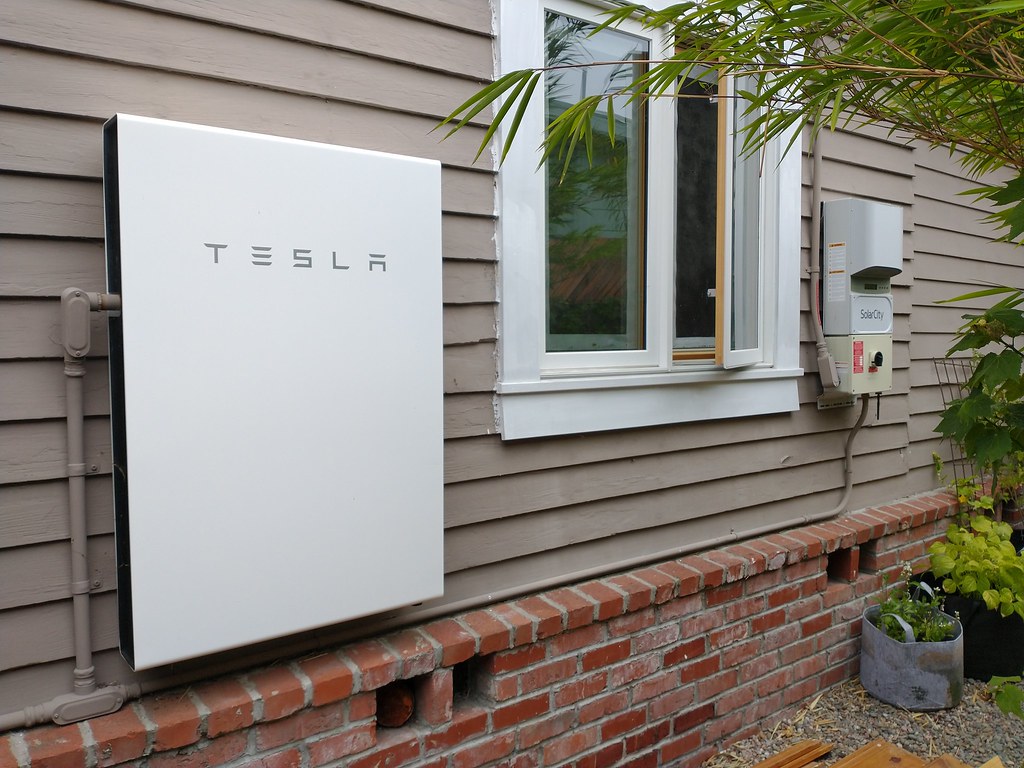
Image: bcpaulos via Flickr, CC BY 2.0
Somewhere around 6 p.m. on a hot day this month, thousands of home batteries quietly started exporting power to the grid — and their owners got paid for it. That is a virtual power plant, or VPP: software that pools home batteries, Powerwalls, and some EVs into one big grid resource. Utilities pay for the help, and in 2026 the money has moved from pocket-change territory to something worth planning around.
Why Utilities Suddenly Want Your Battery
The grid's hardest hours are the summer evening peak, when air conditioners run flat out and solar production fades. Building gas peaker plants for a few hundred hours a year is expensive. Borrowing stored energy from homes is cheaper, faster, and already built. The US Department of Energy says tripling VPP capacity to 80–160 GW by 2030 could cover 10–20% of peak demand and save roughly $10 billion a year in grid costs. That is why programs multiplied fast: operating VPP capacity in North America has passed 37.5 gigawatts, and the residential slice is the fastest-growing part.
The scale is easiest to see in California. Sunrun's CalReady program now aggregates roughly 75,000 batteries across 56,000 homes — the largest virtual power plant in the country. "Customers with home batteries are a solution to alleviating strain on our electric grid," Sunrun CEO Mary Powell said in the company's announcement. "They become powerful grid assets, delivering affordable, reliable power exactly when and where it's needed for communities and across the grid." Tesla, meanwhile, reported paying Powerwall owners about $9.9 million through its VPP programs in a single year, per Electrek.
DOE 2030 Target
80–160 GW
of VPP capacity, covering 10–20% of peak demand
Largest US VPP
~75,000
batteries in Sunrun's CalReady fleet
Tesla VPP Payouts
$9.9M
paid to Powerwall owners in one year
Typical Owner
$500–$1,500
per year, depending on region and program
The Programs That Pay, Region by Region
Payouts vary wildly by state because grids and rules vary wildly. These are the headline programs in mid-2026:
Two things jump out from that board. First, the Northeast pays best per battery: ConnectedSolutions is a capacity-style program, so it rewards a battery that shows up reliably all summer. Second, Texas is the wild card — ERCOT's grid now holds about 14 GW of battery capacity, and wholesale prices still swing hard during heat waves and cold snaps, which is exactly when sellback credits balloon.
Estimate Your Own Payout
Plug in your battery size and region below. The ranges use the published program rates above plus typical owner-reported results; your utility's numbers control what you actually get.
VPP Earnings Estimator
How Enrollment Actually Works
The good news: joining is mostly a phone-screen task, not a paperwork project. The path looks like this. You check eligibility — your battery brand, your utility, and your state all have to line up, and sites like your battery maker's grid-services page list supported programs. You enroll through the app: Tesla, Enphase, SolarEdge, and Sunrun all surface VPP sign-up inside their own software, and the aggregator handles the utility paperwork. You set a backup reserve — the floor the program cannot discharge below, typically 20–30%. Then dispatch runs itself: on event days the battery exports during the peak window automatically, and payment arrives as a bill credit, a check, or an app payout, usually at season's end or monthly in Texas.
One quirk worth knowing: some programs pay on performance (what you delivered during events, like ConnectedSolutions), others pay on enrollment (a flat rate for standing by, like CalReady's per-battery payment). Performance programs pay more but depend on your battery being charged when events hit — solar owners have a structural edge there.
The Fine Print: Check These Five Things First
- Backup reserve control. Confirm you can set the minimum charge the program leaves behind. If outage protection is why you bought the battery, set 50% or higher and accept smaller checks.
- Warranty math. VPP events add cycles. The impact is modest — roughly 3–10% more annual cycling in typical programs — but read your warranty's throughput limits and confirm the manufacturer blesses the specific VPP.
- Exit terms. Programs that gave you an upfront battery discount or signing bonus sometimes claw it back if you leave early. Know the minimum term before you tap "enroll."
- Advertised vs. actual. Headline numbers assume perfect participation. Owners in Massachusetts forums report real payouts landing 20–40% under the marketing math when batteries start events half-charged.
- Rate-plan interactions. Some programs require switching electricity providers or rate plans. Compare the whole package — VPP pay, new rates, export credits — not the incentive alone.
Is It Actually Worth It?
Run the numbers against the hardware. A single Powerwall 3 installed costs roughly $15,000 before incentives. A ConnectedSolutions owner clearing $1,200 a year is recovering 8% of that annually just from VPP checks — on top of solar self-consumption and outage protection the battery already provides. In Texas, $600–$1,000 a year plus time-of-use arbitrage does similar work. In California the per-event pay is thinner, but stacking CalReady or DSGS with export credits still turns a sunk cost into a yielding asset. The battery you bought for blackouts now behaves like a small dividend stock bolted to your wall.
The direction of travel matters too. Grid operators keep adding programs because home batteries solved a problem they have. As more states copy the ConnectedSolutions model and ERCOT-style markets open to aggregators, payouts are more likely to spread than shrink over the next few years.
Your Move Before Peak Season Ends
If a battery already hangs on your wall, you are leaving money on the table every event day you sit unenrolled. Open your battery app tonight and look for the grid-services or VPP tab — most owners find they qualify for something. Set your backup reserve where you can sleep, read the exit terms once, and enroll before the next heat wave. And if you are still shopping for a battery, price the VPP income into the purchase: in the right state, the grid itself now helps pay off the hardware.